I hope you all have had a wonderful Chinese New Years. We welcomed in the year of the Monkey last week (along with Valentines Day and the beginning of Lent--busy week!) with family dinners, performances in our community, making banners with friends, and wrapping jiǎozi with classmates. It's a wonderful time of year to share our love of Chinese language and culture with others.
Here are some great ideas and resources I've stumbled across, perfect if you are still celebrating the New Years (you have until Lantern Festival: February 22)
1. Make a Chinese New Year poster.
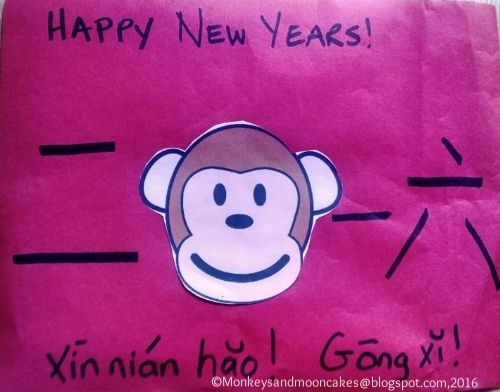
I saw this idea on Hubpages and decided to adapt it for my beginning Mandarin class who just learned how to write numbers one through six (below left)
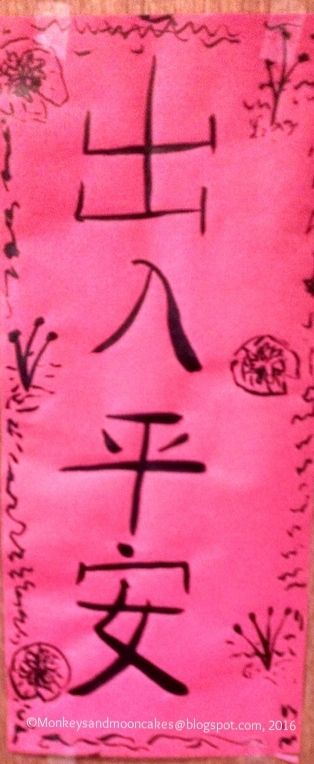
We painted the couplet 出入平安 (Chūrù píng'ān, Peace when you come and when you go)with calligraphy brushes and ink on red paper from our local school supply store. No calligraphy brushes? No problem! You can easily use sharpies (jumbo sized for big characters).
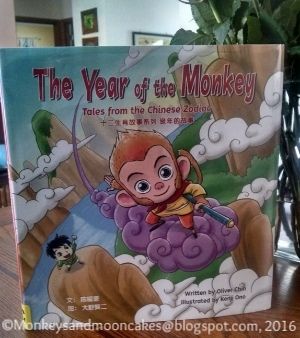
3. Read The Year of the Monkey,Oliver Chin's latest book in the Tales from the Zodiac series (Immedium: 2016)
About the book: The 11th book in this 12 book series, The Year of the Monkey tells the
adventures of Max (son of the famous Monkey King) as he searches to find his
fate.
What we love:
1. The
story is full of Monkey king action. If your kids like Kung Fu Panda, this
book will be a hit.
3.
It's bilingual! No pinyin provided, but if you can read Chinese characters, you
can read it in Mandarin.
4. Share Chinese New Years legends and traditions with friends through this cute video.
I stumbled across this cute and concise video produced by the fast-food chain, Panda Express (Nope, they didn't pay me=) when planning a Chinese New Year lesson for my beginning Mandarin class.
Super cute animation. It tells the origin of the Chinese New Year, the origin of the Zodiac calendars, and how the holiday is celebrated today. Check out Panda Express's CNY website to download free Chinese New Year printables.
5. Learn a New Years Song! Here are two of our favorites:
Gōngxǐ Gōngxǐ by BadaNamu
Sung in Mandarin at the beginning and then translated to English. If the verses are too complicated, learn the chorus: Gōngxǐ gōngxǐ gōngxǐ nǐ (Congratulations to you!), which is what you say to someone during the New Year.
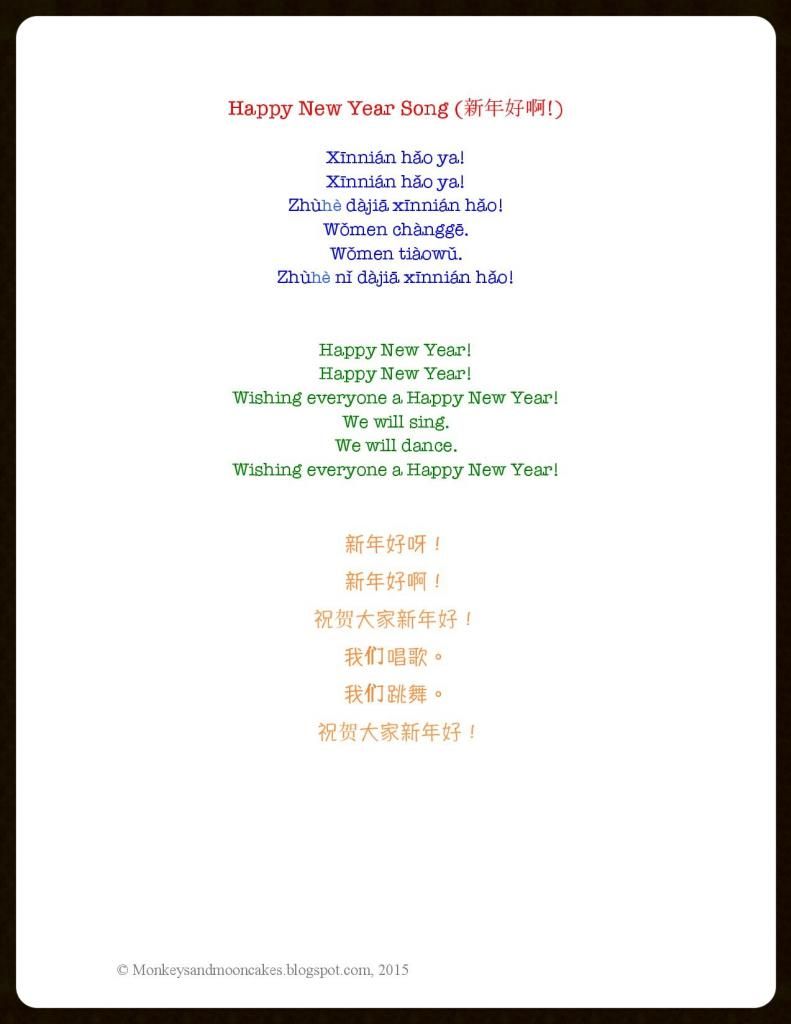
Xīnnián hǎo ya (Happy New Years!) Mandarin lyrics and English translation posted here.
The holidays have passed, and although we haven't had a real winter yet (according to the kids), the winter doldrums have set in and we (...um..that would be me) have begun the countdown to spring.
My mother-in-law shared this great Mandarin poem that was used long ago in China as a way to keep track of the days between Winter Solstice and the spring planting season, The Number Nine Song (数九歌, shǔ jiǔ gē).
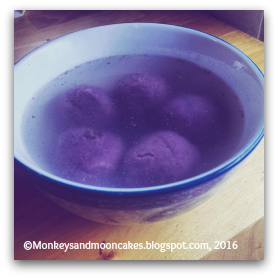
Winter Solstice(冬至, dōngzhì) is a Chinese holiday celebrated by family get-togethers and tāngyuán (汤圆), which are those wonderful glutinous rice dumplings with sweet or savory fillings (my favorite are black sesame paste), floating in a vat of steaming hot water. Yum!
Back to the poem:
Number Nine Song describes the changes in the weather that occur between the Winter Solstice and the beginning of the spring planting season from a child's perspective. Time is counted in increments of 9 days, so the "1st 9" in the poem refers to the first 9 days beginning from the Winter Solstice, the "2nd 9" the 9 days after that, and so on.
Good for intermediate students. Chinese poetry can be confounding (to say the least), but this is a pretty approachable poem for intermediate language learners due to its heavy use of numbers.
It's a riddle!Once you understand that the 9's in the poem refer to increments of 9 days, the poem can be used as a riddle. Have your kids figure out when the 1st 9, 2nd 9, 3rd, 9, etc... occur (Hint: Winter Solstice was December 22 last year).
Great lesson idea for Winter Solstice. Yup, it's already passed this year, but put it on the calendar for next year (December 21, 2016) and plan to eat some steaming hot tāngyuán (or eat those now just because you never need an excuse to eat tāngyuán).
You can hear it performed on a goofy youtube video. There is a goofy youtube videothat animates the poem's text (recited by children). FYI: the third line of the poem slightly differs in the video.
Happy 2015! I hope that you had a wonderful holidays with your loved ones.
Our holiday break began like this:
and this:
but then it started to look like this:
The flu hit us all! But by the time New Years rolled around, we were finally all healthy again, and ready to start thinking about the exciting times ahead of us.
*******************
This past week, I've been exploring some new materials and brainstorming lots of great activities and games to use my kids' Mandarin lessons. I can't wait to share these with you in 2015!
Until then, let me leave with a New Years song: The Happy New Year Song (sung to the tune of "Oh My Darling, Clementine"). It's technically a Chinese New Year's Song--CNY isThursday, Feb. 19 this year. Put it on your calendar! But we are going to sing it this week because singing is a great way to practice our Mandarin.
After our first lesson on weather, I began looking for a catchy way to practice our new weather vocab, plus review/reinforce some other words we've been working on.
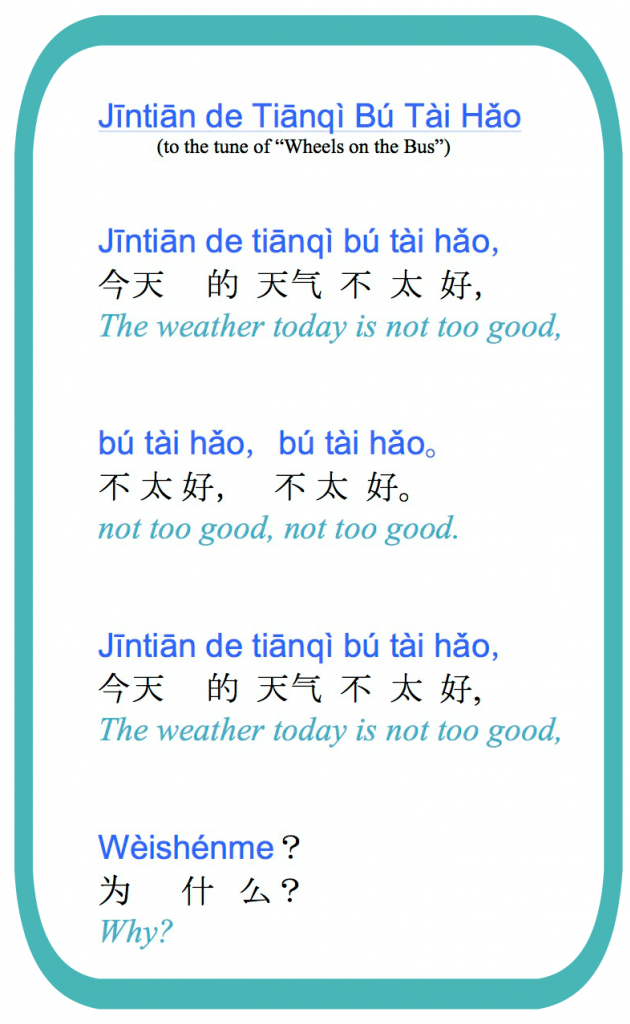
The sentence "Jīntiān de tiānqì bú tài hǎo" (The weather today is not so good) got stuck in my head, and after mumbling through it a few times, I realized that it would work well sung to the tune of "The Wheels on the Bus."
After a little caffeine (i love my java) & creative brainstorming, a Mandarin song and game about the weather was born!
First, the song:Sung to "The Wheels on the Bus." It's a super catchy tune, one you've probably sung a million times between storytimes and preschool with your little ones.
Sing through the song. After singing "wèishénme?," point to a player.
This player turns over a weather card and answers in Mandarin, "Jīntiān lěng" (or Today is cold)
Repeat the process until everyone has had a turn.
**The girls had recently learned the word "yīnwèi" (because), so they began their answer with "yīnwèi" and then filled in the weather condition.
**To make it more challenging, I threw in other weather conditions (Hěn lěng--very cold, and Bú tài rè--not too hot, Xià dàyǔ--heavy rain)
Now, the silly part:
To switch things up, I introduced the stack of food cards.
This time through, after we sang through the song, and asked "wèishénme?" whoever was it, turned over one card from each pile.
Instead of answering in Mandarin, the kiddo translated the weather card into English and combined it with the item on the food card to create a funny weather condition (i.e. it's snowing pancakes)
**This takes a little imagination, but it really stretched their "translating" muscles and made them giggle.
What songs have you created to help you learn and/or teach Mandarin?