Image Map
Showing posts with label Flashcards. Show all posts

Thursday, March 3, 2016

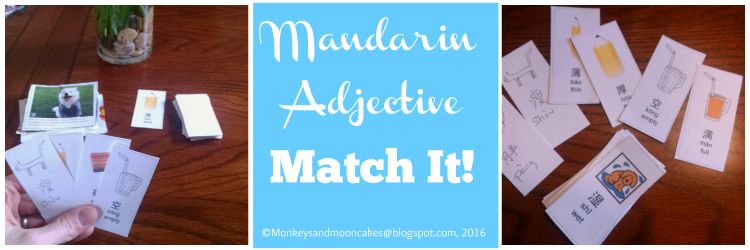
Mandarin Adjective Match It

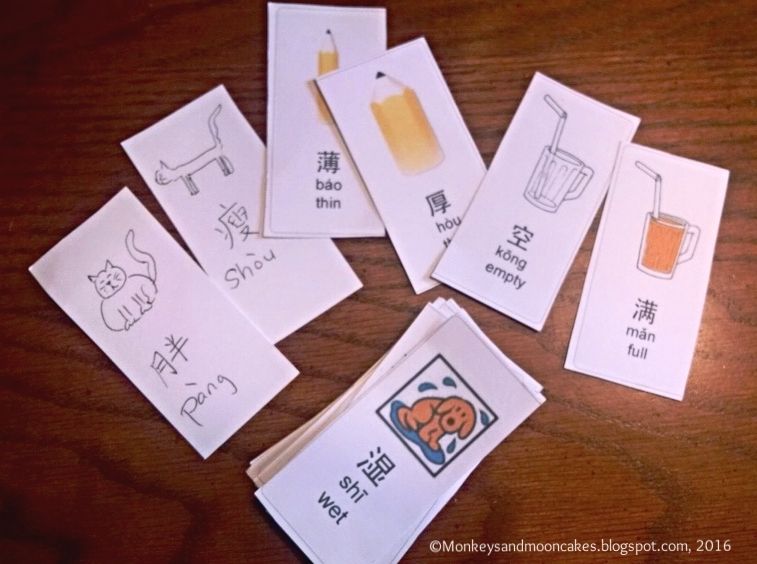
The big kids have started a new unit on adjectives. We're moving beyond dà (大, bigand xiǎo (小, small), to words like thick and thin (hòu, 厚; báo, ), short and tall (Ǎi, 矮; gāo, 高), heavy and light (zhòng, 重; qīng, 轻)

To help the girls learn this new vocab, I found a game called Adjective Match It on Busyteacher.org. It's designed for the ESL classroom, but I thought it would be great for helping the girls become more familiar with our new set of Mandarin adjectives. 

A bit like Gin Rummy, the goal of Mandarin Adjective Match It is to collect four adjective cards that best describe the selected picture card.


Prep:

These images are shared under a post about antonyms so not all are adjectives. They print out in pairs so I cut each card down the center to make smallish rectangular cards. I also made some adjective cards of my own to supplement. 
  • Cut out from magazines or print from internet 4-5 pictures that can be described using a variety of the adjective cards. You can use anything really. I looked for pictures that included more than one person, animal or object. 
  • Shuffle the adjective card deck and deal four cards to each player. Don't forget to count in Mandarin!
  • Place the remainder of the adjective card deck face down in the center of the table.
  • Choose a card from the image pile and place it face up on the table.


How to play:

  1. Player 1 discards one adjective card from her hand, the one that least describes the chosen image card, and draws a new adjective card from the deck. 
  2. Player 2 does the same. 
  3. Play continues until one of the players has four adjective cards that describe the image card and declares "Wǒ yíngle" (我赢了, I won!)
  4. Play 1 round or 20!


The Challenge:

Once your Mandarin students become familiar with the new adjective vocab, add another level of difficulty by requiring them to "make a case" for each of their winning adjectives.

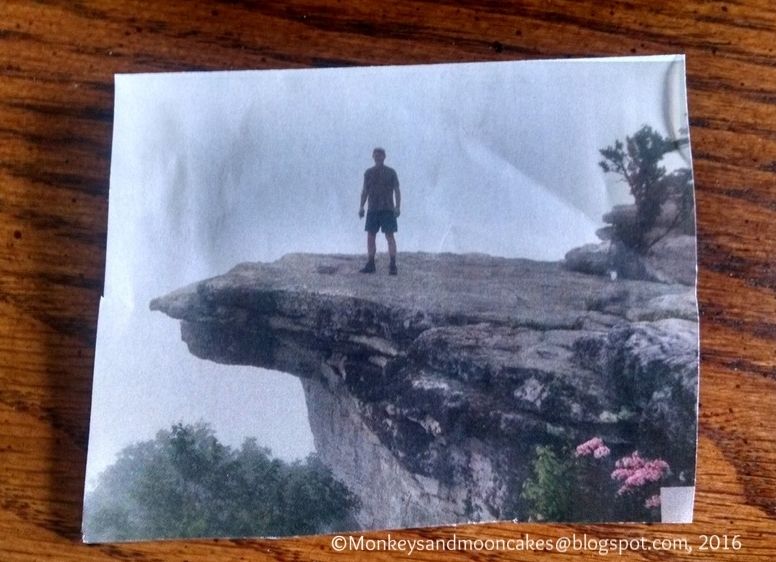
For example, one of the girls won a round by using the adjectives "heavy" "wet" "tall" and "thick" to describe this picture    ----->

She said, "Shítou hěn yìng, yě hòu. Kōngqì hěn shī. Nánrén gāo." (石头很重,也厚。空气 很湿。 男人高." The rock is very hard and thick. The air is wet. The man is tall.) 

As long as they tried to explain their "win" (perfect grammar not necessary!), I let them keep the win: they held on to the picture card. 


How do you use games to practice new vocab?


post signature

Thursday, December 17, 2015

3 FUN! Activities and Games Using Flashcards in Mandarin Learning

Let me start by saying that I've never been a fan of flash cards as a tool for learning Mandarin. They bring back memories of hours and hours spent falling asleep... ...er...memorizing Mandarin vocab as a student. I'm sure I benefited in some way from my flashcards, but they did not engage me in learning Mandarin the creative and active way I want my kids to learn. 

So lately, I've been re-thinking flash cards, using them as a jumping off point for active and creative language learning. 

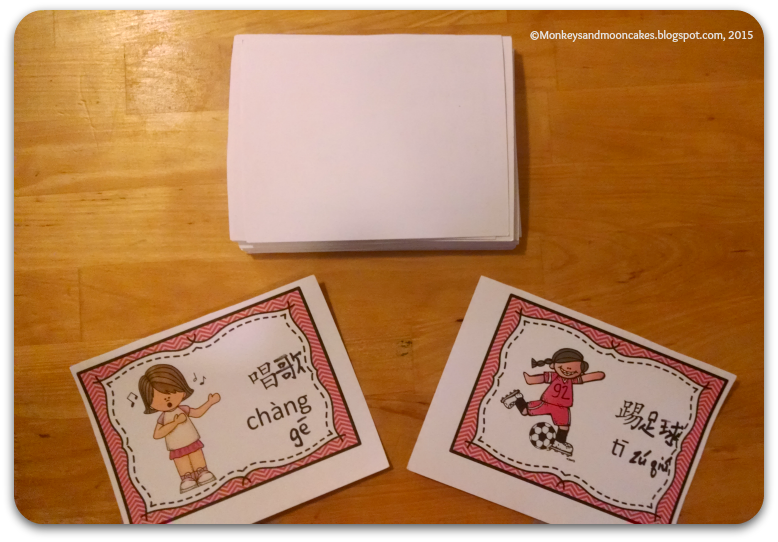
I downloaded this set of action word flashcards from Teachers pay Teachers in effort to expand our verb vocabulary this fall. I liked the cute illustrations on the cards and that they included pinyin (they didn't include the often-used verb-object combinations though, so I wrote on them).

Each week, I've used this set of action cards in a different activity or game. Now that the girls are familiar with most of the vocab, I'm adding my own winter activity verb-object flashcards to the deck (Click here to download). 

Read on for 3 fun activities and games that use flashcards in Mandarin language learning. 

1-2-3 At a Time

This is a great game to play immediately after introducing a set of 10-12 new verbs. It's an active game for 2 or more players, which can result in fits of giggles. 

  1. Introduce a set of 10-12 verbs to your students. Have your students repeat the word in Mandarin after you, while simultaneously performing the action you've selected for the verb. 
  2. Once you have gone through the set, place the verb cards face down in a pile.
  3. Choose someone to be the first "actor." Have them choose a card from the deck, and perform the action that goes along with the card they have chosen for the rest of the students, "the audience." 
  4. The "actor" must continue to perform the action until the "audience" yells out the correct Mandarin word that matches the action.
  5. Switch "actors" and repeat the process.
Challenge: When your students become familiar with the deck of cards, challenge them by asking the actors to choose 2 cards (and perform 2 actions at a time) until the audience guesses both actions. If this is still too easy, try 3 cards (3 actions). The silliness of performing 2 or more actions at the same time (e.g. singing while drinking water) will make this game a hit with your kids and make the vocab stick in their brains!

Memory Match

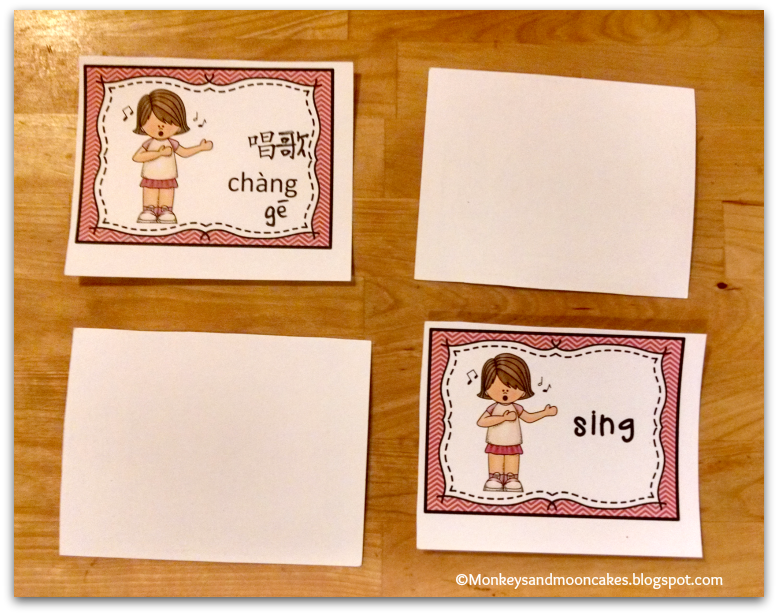
This is another great way to reinforce new Mandarin vocabulary. Play this game just like the well-known childhood game, except you'll be matching the pinyin action card to its corresponding English card. 
Tips: 
  • Start with a small stack of new vocab (6-10 action cards and their matches). When your students become familiar with these cards, add in a few extra sets of matching cards. 
  • Each time your student takes a turn, encourage them to say the Mandarin word they choose out loud as a way to familiarize themselves with pronunciation. 

Sentence Generator

I came up with this activity after noticing that the girls, although familiar with the vocab we had been studying, were struggling to use the new words in sentences they generated by themselves. I decide to use the action flashcards as our "word bank" for a question and answer pattern we were practicing. 

  • We placed the action flashcards face down in a pile, our "word bank.
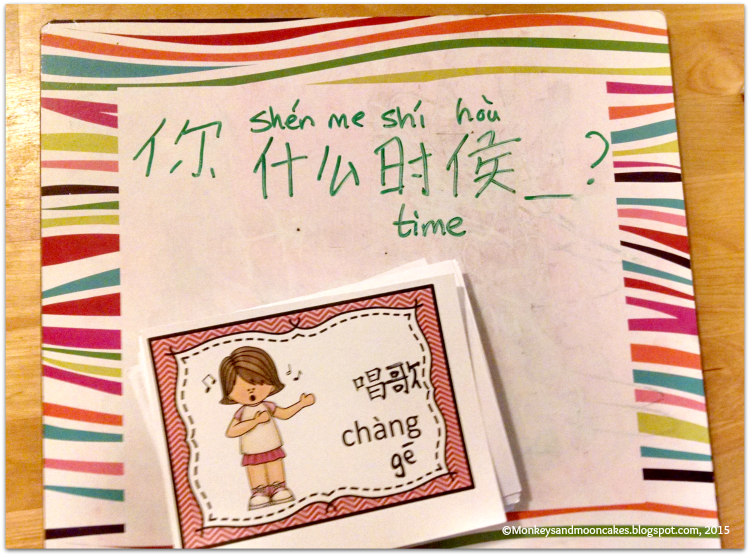
  • The "asker" chose an action card from the pile and used it in the sentence pattern we were practicing,  你什么候 (insert verb from card)?” (When do you ____? Nǐ shénme shíhòu
    ?)
  • The "answerer" responded with a truthful answer, or when they got stuck, we broke out another stack of time flashcards and used them to help generate a response. 

That's just a snapshot of how we've been using flashcards lately. I'd love to know how you use flashcards in Mandarin language activities and games!

post signature


Sunday, December 13, 2015

Mandarin Winter Verb-Object Flashcards

Hi all!

I'm working on a new post on FUN! activities and games for incorporating Mandarin language flashcards into lessons. 

While I'm hard at work, I'd like to share a free flashcard printable with you...just in time for winter! 

Click here to download

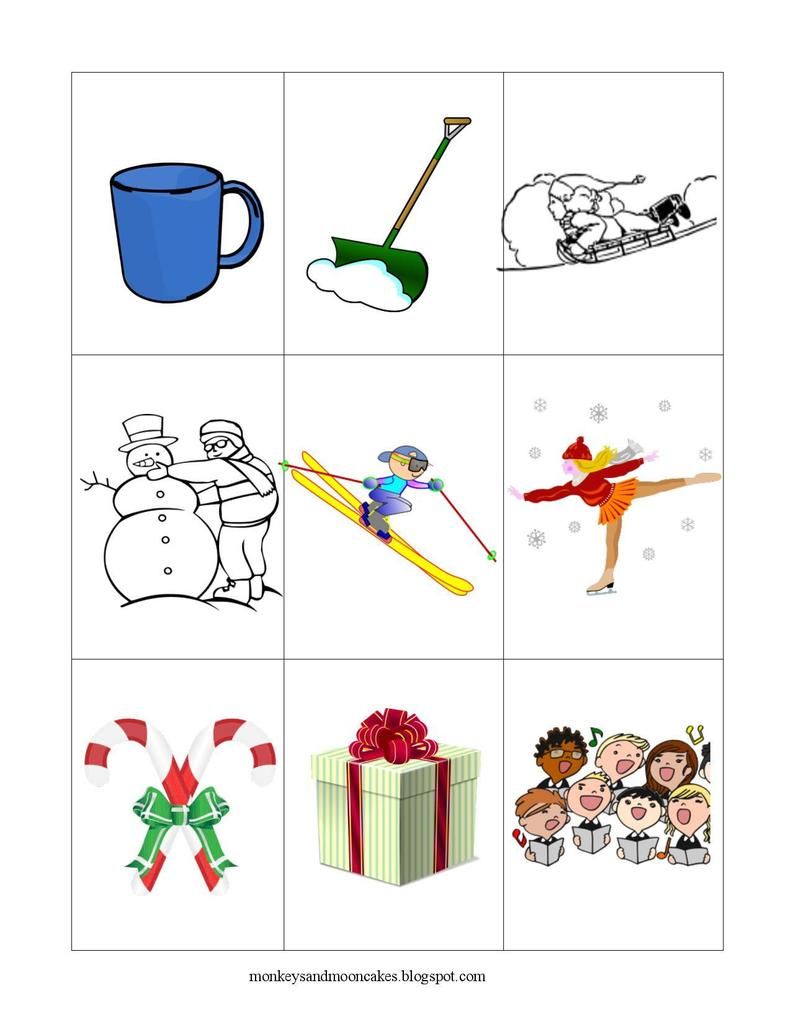
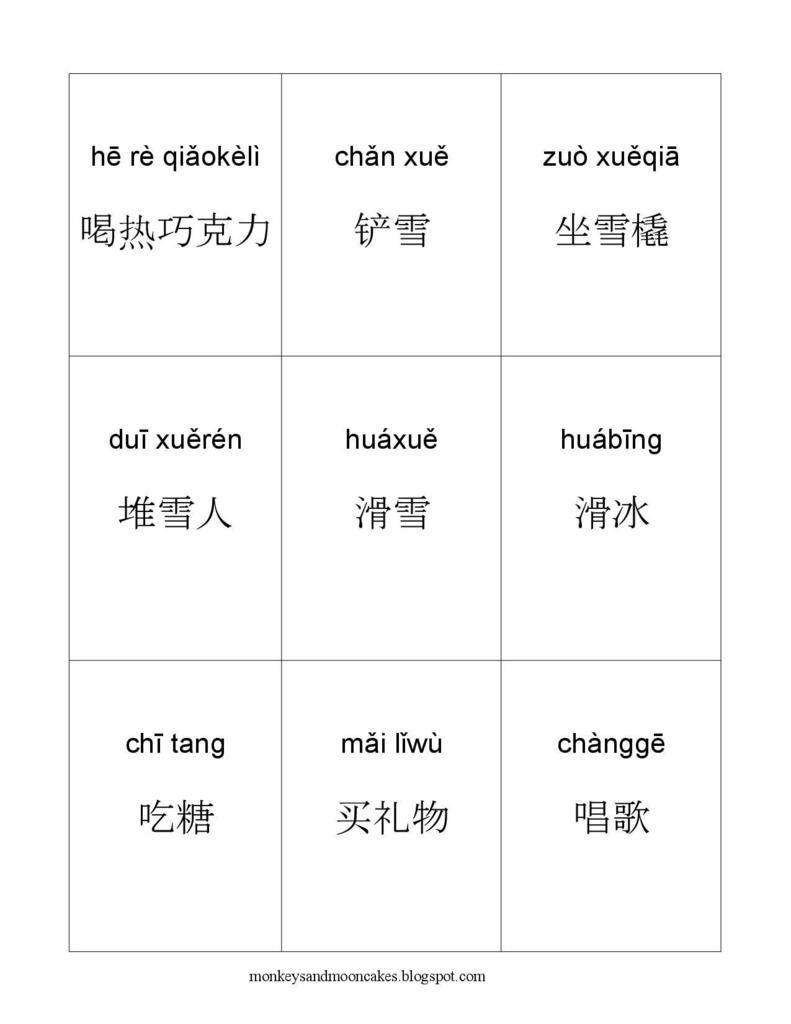
I've included both pinyin and Chinese characters for 9 Mandarin verb-object combinations related to winter activities. 

Print on 2 pages to keep the illustration and translation on separate cards or print 2-sided if you want the translation to appear on the opposite side. 

Enjoy!
post signature